
Trusted by organizations with real operational complexity.
Real work runs through these sites every day. They have to hold up when it does.

Members join, renew, and self-serve. Staff run it without waiting on a developer.
Raise money, recruit volunteers, and tell your story, on a site a small team isn't afraid to touch.
Enrollment, payments, and course access that hold up for students, alumni, and faculty over years.
Grant programs, public resources, and reporting on a platform meant to outlast one initiative.
These websites do the work















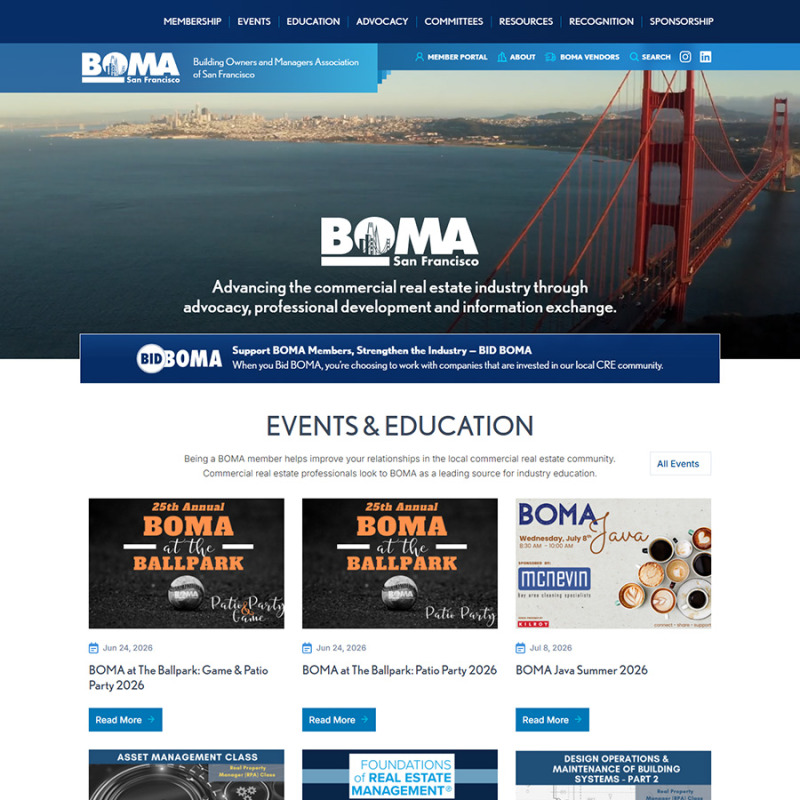
An advocacy and membership hub for commercial real estate.
BOMA SF speaks for property professionals in one of the country's most competitive real estate markets. The site has to carry legislative updates, committee work, event registration, and member resources, all run by a small staff. Aero built it, and rebuilt it, around content the team controls and members can rely on.
Staff publish news and alerts without waiting on developers
Categorized news, advocacy alerts, and committee updates go live through Drupal content tools the team controls.
Members find events, register, and get resources in one place
An events calendar tied to registration keeps programming and signups on the site, alongside the resources members rely on.
Member records stay in sync with the tools the team already uses
The site connects to the association and email systems the staff depend on, so records and outreach line up.
One partner across the lifecycle of a digital platform.
Most organizations don't need three different vendors. They need one team that can build what's next, keep it running, and help them make smarter digital decisions.
Design and develop the platform
Websites, membership portals, event experiences, content systems, and the CRM integrations that tie them together.
Keep it stable, secure, and fast
Managed hosting with monitoring, backups, and proactive updates. When something needs attention, you reach someone who knows your site.
Know what's working, and what's next
Website analytics, digital fundraising strategy, content strategy, and guidance on where your channels can do more.
Connected to the systems your team already runs on.
Your website shouldn't work in isolation. We connect it to your CRM, AMS, email, and the rest of your operation, so records stay in sync and nobody re-enters the same data twice. From single sign-on to AI-assisted workflows, the integration work is ours to carry, not your staff's.












The real testimonial is what clients keep trusting us with — years later.
Not a wall of quotes. The proof is the length of each relationship and the operational responsibility behind it.
These websites do the work
View all Case StudiesAero has been BOMA San Francisco's website partner for 31 years, and Ben and his team have continued to support us as our needs and technology have changed. They helped us redesign our website a few years ago and still manage and support it today.
Ben is responsive, patient, and genuinely easy to work with. He knows our organization and our website well, and I always feel comfortable reaching out when we need help, have a new idea, or need something handled quickly.

The professionalism, creativity and commitment to executing the larger vision of our site has made working with Aero a dream. As a novice in website building, I’ve been exceedingly grateful to work with Aero; they’re patient teachers and have helped us elevate our site into a place we had only dreamed of.

Built to work. Built to last.
Built with care.
Aero's advantage is not just design taste or technical execution. It is continuity: the same team understands the mission, designs the system, supports the staff, and improves the platform as needs change. The sites we built years ago are still running. So are the relationships.
Want a partner who's as interested in how it runs as how it looks? Let's talk.
The site has to support the workflows behind the mission: publishing, registration, membership, donations, resources, reporting, and support.
The public experience should feel clear and credible. The admin experience should help staff move faster without breaking structure.
Technology decisions should make the next five to ten years easier, not create a fragile launch moment that ages immediately.
Questions a cautious nonprofit or association leader is already asking.
You're not buying a visual moment. You're trusting someone with the system your staff and community may rely on for the next decade. Our 30 years is only useful if it earned us judgment: knowing what to keep, what to modernize, and what's just the trend of the year. Ask us what we'd build differently today than we did in 2015. We'll have an answer.
If your site mostly needs to look good and collect the occasional form, yes, and we'll say so rather than sell you something heavier. The catch shows up later. Builders are rented space: your content, your members, and your data live inside someone else's product, on their terms, and moving out is deliberately hard. The moment your operation outgrows the template, you hit a ceiling you can't lift, and the "cheap" option becomes the reason for the next rebuild. We'd rather you own the thing your mission runs on.
Honestly? Not for every project. For a marketing site, you have better options. But when an organization needs to manage members, run programs, publish a magazine, sell event tickets, and integrate it all with how the staff actually works, Drupal still does this better than the alternatives, and it stays yours. We've watched a lot of SaaS platforms come and go. The Drupal sites we built ten years ago are still running.
Sometimes it's the right call, and we'll tell you when it is. For a content site, a campaign, or a small org that mostly publishes and takes donations, WordPress launches fast and help is easy to find. It gets expensive when the real work piles up: gated member content, complex registrations, role-based permissions, integrations that have to stay in sync. That usually becomes a stack of plugins that each update on their own schedule, and the site that was supposed to be simple turns into the one nobody wants to touch. The platform should match the operational load, not the other way around.
Then we don't force it into one. Most of our work starts with a conversation about the operating problem: what's stuck, what's stalling, what's about to break. From there we shape the engagement. Sometimes that's a full build, sometimes an audit, sometimes a focused intervention on one workflow. Our services are how we describe the work, not how we sell it.